Our Learning Approach: Experience and Reflect on Leadership in a Safe Framework
At Leaderfy, the development of leaders is at the core of everything we do. Our holistic learning approach is designed not only to impart theoretical knowledge but also to make the complexity of leadership tangible through active, motivating, and interactive learning processes.
Structure of Our Learning Approach
Our learning approach is designed not just to make the complexity of leadership understandable, but to make it experiential through active, motivating, and social learning processes. To this end, we have developed a multidimensional learning approach based on three pillars: the digital Leaderfy Game, Social Learning, and Coaching & Learning Support. These elements work together synergistically to promote a deep understanding and the effective application of leadership skills. We are convinced that true leadership competence is not so much imparted by traditional teaching methods, but rather through experiencing and reflecting on real leadership situations.
- Digital Leadership Game
The digital Leadership Game serves as the common thread in our leadership development programs and training, creating an experience-based learning environment where leaders can navigate realistic leadership challenges in a risk-free setting. Our Leaderfy Game is designed to cover a wide variety of subject areas.
- Social Learning
Through Peer Learning & Networking—we use the term Social Learning here—our participants have the opportunity to share their experiences and insights with others, learn from one another, and build a strong professional network. This exchange is crucial for deepening what has been learned and gaining new perspectives.
- Coaching & Learning Support
Learning support from experienced coaches allows our participants to receive personal feedback and expert input tailored to their specific challenges. This not only supports the learning process but also promotes the application of the learned skills in practice.
- Experiential Learning
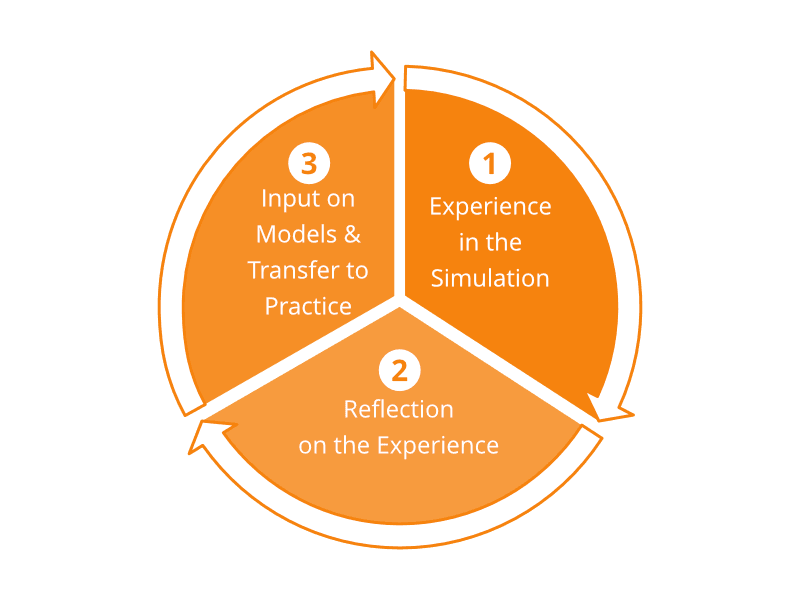
Figure: Learning and Development Concept
Leadership Challenges in the Leaderfy Game
The following illustration gives an overview of the leadership challenges in the Leaderfy Game:
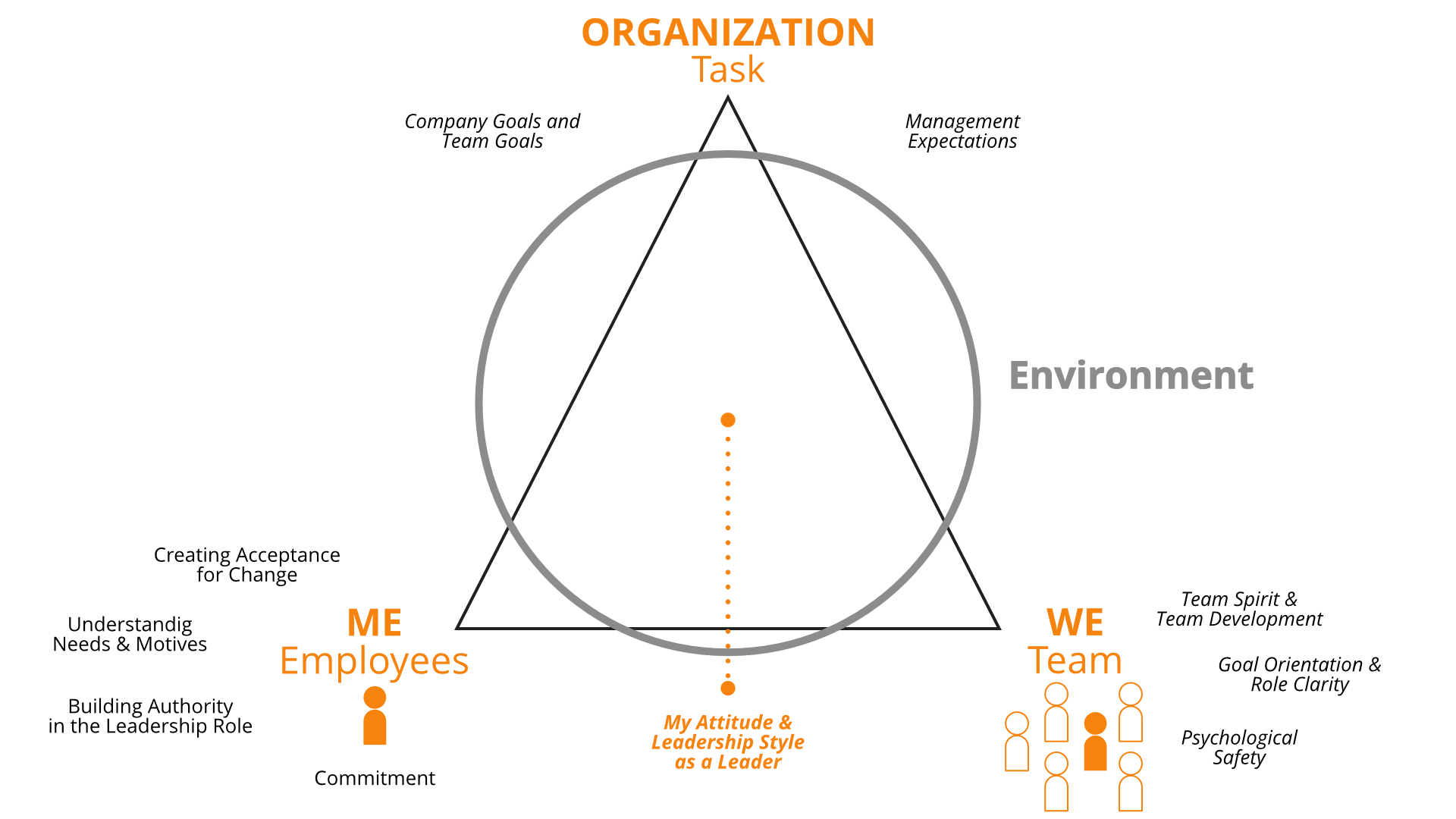
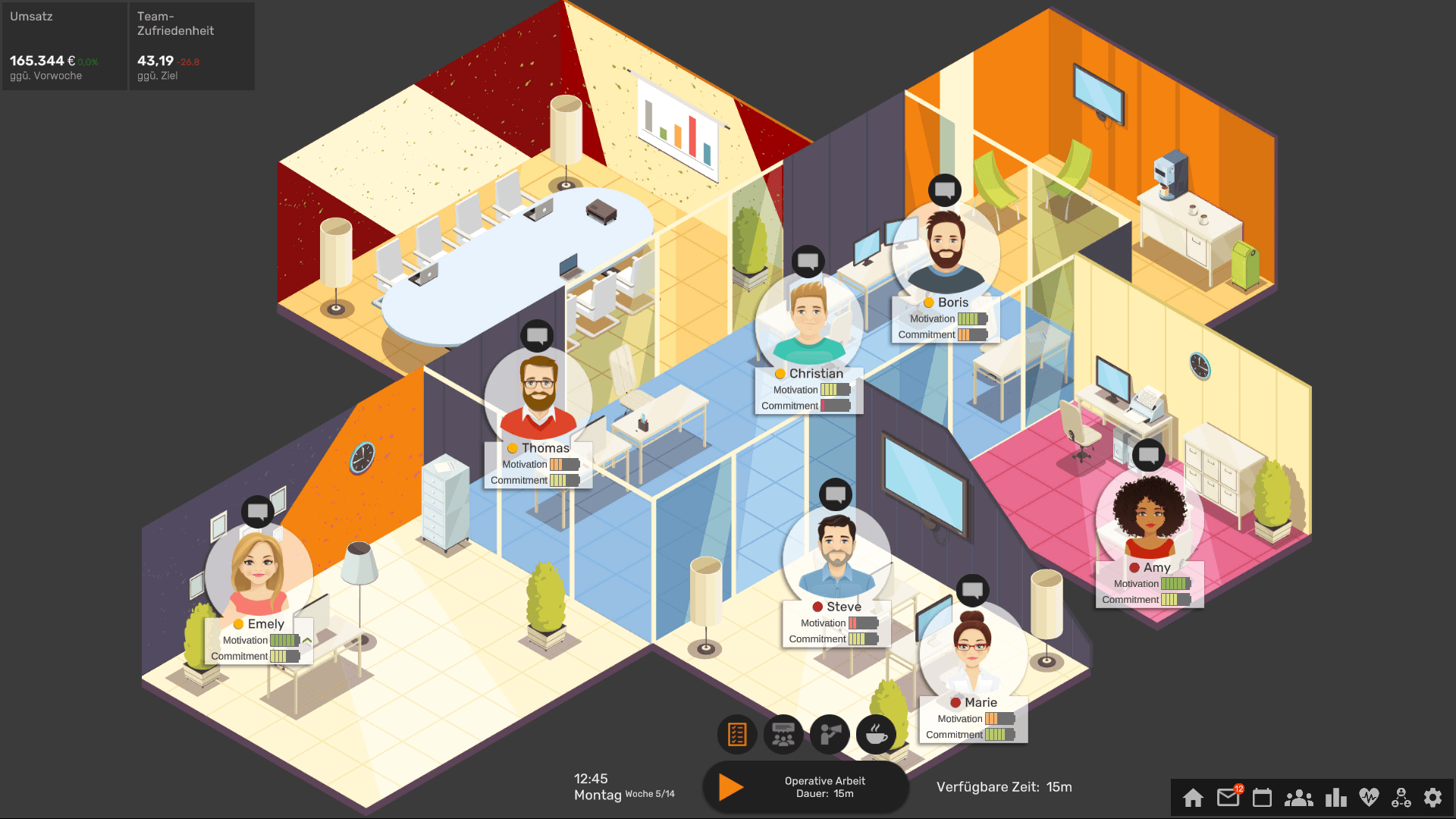
From flexible playing time and an extensive range of action options to complex character modeling based on recognized psychological models—every aspect of the game is designed to offer you an immersive and challenging leadership training experience. The following overview shows how these elements interact to create a realistic leadership experience that prepares you for the diverse challenges of the modern workplace.
Over a period of 5 to 14 virtual weeks, your goal is to achieve ambitious targets together with your new team. In doing so, you operate within a field of tension created by the differing interests and expectations of customers, your company, individual employees, and your team as a whole.
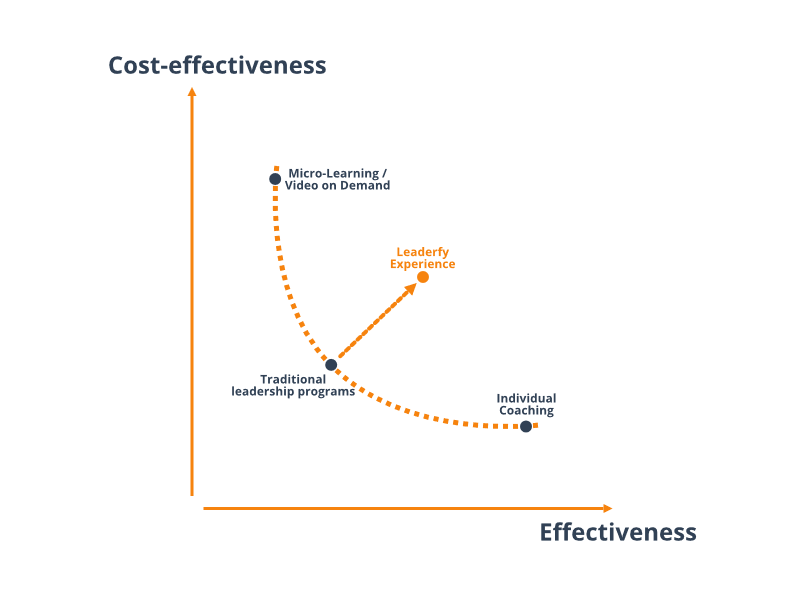
Advantages and Effectiveness of Our Approach
Our learning approach combines cost-effectiveness with high impact. Compared to traditional leadership programs and individual coaching, Leaderfy offers above-average results and a better cost-benefit ratio. Our innovative mix of a digital leadership game, peer learning, and learning support/coaching provides a profound and practice-oriented learning environment. While simple micro-learnings and video-on-demand solutions often only allow for superficial learning, our interactive and reflective games promote intensive learning processes and the sustainable development of leadership skills. Participants thus enjoy a comprehensive learning experience that combines depth of content with practical application.
The Added Value of Our Approach
The Leaderfy Game offers a challenging and motivating experience. Instead of merely gamifying learning content, the dynamic simulation model creates a learning environment that is individually suited to the participants.
High Motivation through Playful Learning
The Leaderfy Game can be completed by participants in a self-paced manner and can then be flexibly integrated into various training settings (in-person, online, and blended formats).
Flexible Access and Integration
Each individual participant has unique experiences and receives individual, content-related feedback that precisely matches their own leadership challenges. This means that exactly the topics are taught that are currently necessary to overcome the challenges in the Leaderfy Game.
Intelligent and Adaptive Learning
Leadership can be tested in the Leaderfy Game within the safe framework of a virtual team. The inhibition threshold to deal openly and honestly with certain topics, such as employee management, is lower here, as decisions have no real-world consequences.
Experimentation in a Safe Framework
At the conclusion of the Leaderfy Game, participants receive detailed feedback on their own leadership style. The data for this is based on the decisions made in the game. Participants can continue to work with this concrete feedback, for example, in long-term development programs or accompanying coaching sessions.
Holistic and Well-Founded Feedback
The interconnections in the underlying simulation model are based on current empirical research findings in the fields of work and personality psychology, team development, and leadership theories.
Experience Evidence-Based Interconnections
There is no single optimal solution in the Leaderfy Game. You can make use of the complete spectrum of leadership approaches: from authoritarian leadership behavior to agile and self-organized leadership.
Broad Scope of Action
Scientific Foundation and Methodology
Our learning approach is based on a solid scientific foundation and links proven psychological theories with practical applications for developing leadership skills.
A key innovation of our Leaderfy Game is the integration of the Big 5 personality model and Loevinger's Ego Development model. The Big 5 model, which includes Openness, Conscientiousness, Extraversion, Agreeableness, and Neuroticism, allows for a detailed representation of the virtual team members' personality structures. This helps ensure that the interactions in the game reflect the complexity of real interpersonal relationships.
Loevinger's Ego Development model is used to define the various developmental stages of the characters in the game, from impulsive behaviors to highly integrated personalities. This differentiated representation allows participants to adapt their leadership strategies individually and to respond effectively to both different personality traits and the developmental stages of the team members.
By applying these models, the Leaderfy Game provides a practical training environment in which participants learn to navigate complex human dynamics. This promotes the development of leadership skills and prepares participants to deal with the diversity and individual development needs within their teams. The game creates a valuable learning platform where leaders can deepen their competencies in a controlled, challenging environment.
The Leaderfy leadership simulation is designed to offer a deep and practical learning experience specifically aimed at the development and refinement of essential leadership skills. Our simulation pursues the following central learning objectives:
Participants learn to make effective decisions, even in stressful or unpredictable situations.
Decision-Making Under Pressure
The game enhances the ability to resolve conflicts within the team constructively, thereby creating a harmonious work environment.
Conflict Resolution Skills
Improving the ability to communicate clearly and effectively to ensure that goals and expectations are understood and met.
Communication Skills
Strengthening the ability to lead, motivate, and foster the development of teams to achieve common goals.
Team Leadership and Development
Developing the ability to adapt to changing circumstances and react flexibly to new challenges.
Adaptability
Participants receive valuable feedback on their leadership style and behavior, which stimulates self-reflection and allows them to recognize their strengths and work on their weaknesses.
Understanding One's Own Leadership Role